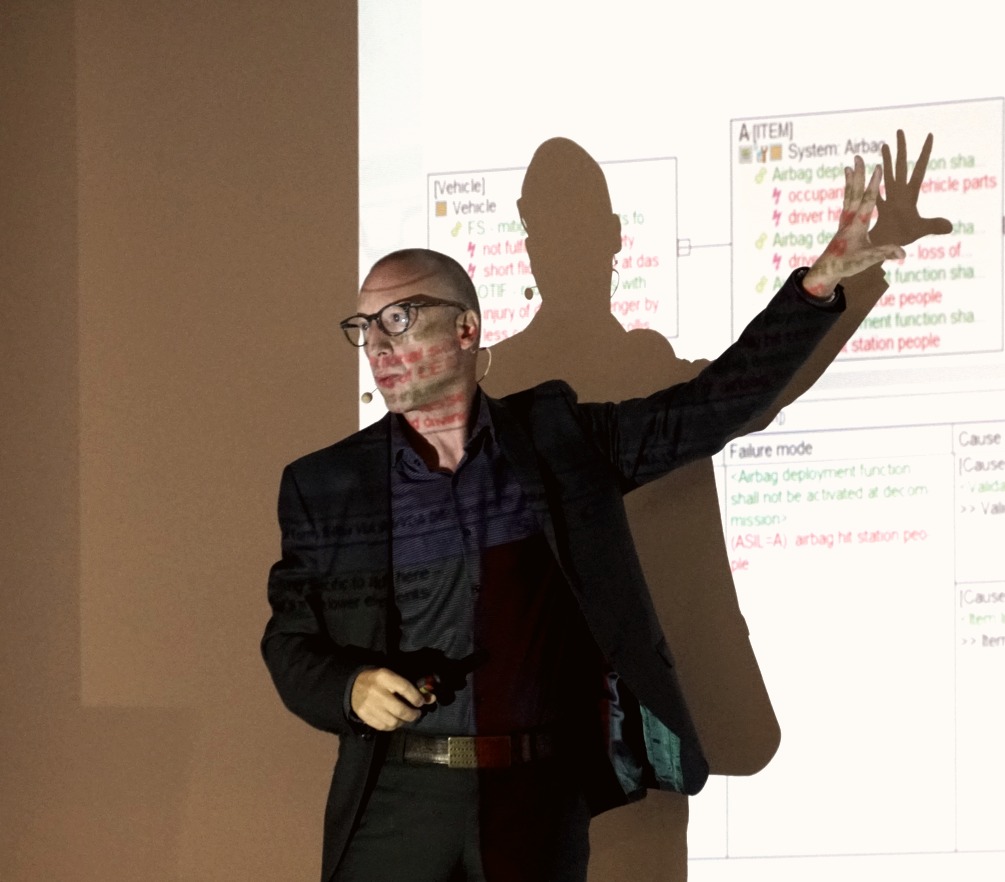
Decades of experience, wildly different environments
For over two decades, we’ve worked at the intersection of people and technology. Our experience spans startups, mid-sized companies and global corporations, as well as national and international organizations and public authorities. That range helps us meet mixed teams and audiences where they are – from technical specialists to executive leadership.
Three disciplines, one mindset
All three areas are closely connected – identifying risks, building in safety and keeping processes compliant are rarely separate concerns.
Risk workshops, safety analyses (FMEA, FTA, FMEDA, HAZOP, hazard and risk analysis, HARA, TARA), AI risk management.
Threat analyses, compliance with current regulation (EU AI Act, Cyber Resilience Act (CRA)).
Process development, maturity assessments (CMMI, SPICE), conformity with standards.
Three examples from corporate projects
Out of respect for confidentiality agreements, deliberately without industry, country or company name.
Introducing FMEA at corporations. At several global corporations, we’ve introduced the FMEA (Failure Mode and Effects Analysis) method from the ground up: from initial rollout through training internal facilitators to tool implementation and company-wide method training – so the organization can run these analyses independently after the project ends.
Core tools rollout. In international corporate environments, we’ve taken ownership of rolling out the core tools APQP, PPAP and Control Plan – from initial concept through implementation across multiple sites.
Coaching functional safety and cybersecurity. Over several years, we’ve supported development teams at large corporations in building management systems for functional safety and cybersecurity. It usually starts with a gap analysis: these systems often call for over 100 work products, and the first task is figuring out what already exists under a different name and what’s genuinely new. Every new standard broadens the field of methods – alongside the classic FMEA, that often means a HARA (Hazard Analysis and Risk Assessment, focused on hazards) and, for cybersecurity, a TARA (Threat Analysis and Risk Assessment, focused on deliberate attackers). Our job is to bring clarity to this growing thicket of terminology.
No ivory tower, just hands-on
Turning complex technical and regulatory requirements into something teams understand and can apply directly – that’s our work. Not ivory-tower consulting, but hands-on facilitation and training, aimed at helping clients master these topics independently. Sound expertise is made accessible: grounded in practical experience, with mature, well-founded materials as the toolset.